




Economic security cooperation deepens between India and Japan

New Delhi, July 02: India and Japan today approved a joint roadmap for economic security through which both the countries will work with a huge investment of 100 trillion yen to make the supply chain flexible and strong in strategic sectors like semiconductor, quantum and advanced materials. Apart from this, an agreement was also reached to set up one thousand biogas plants in India in collaboration with Japan.
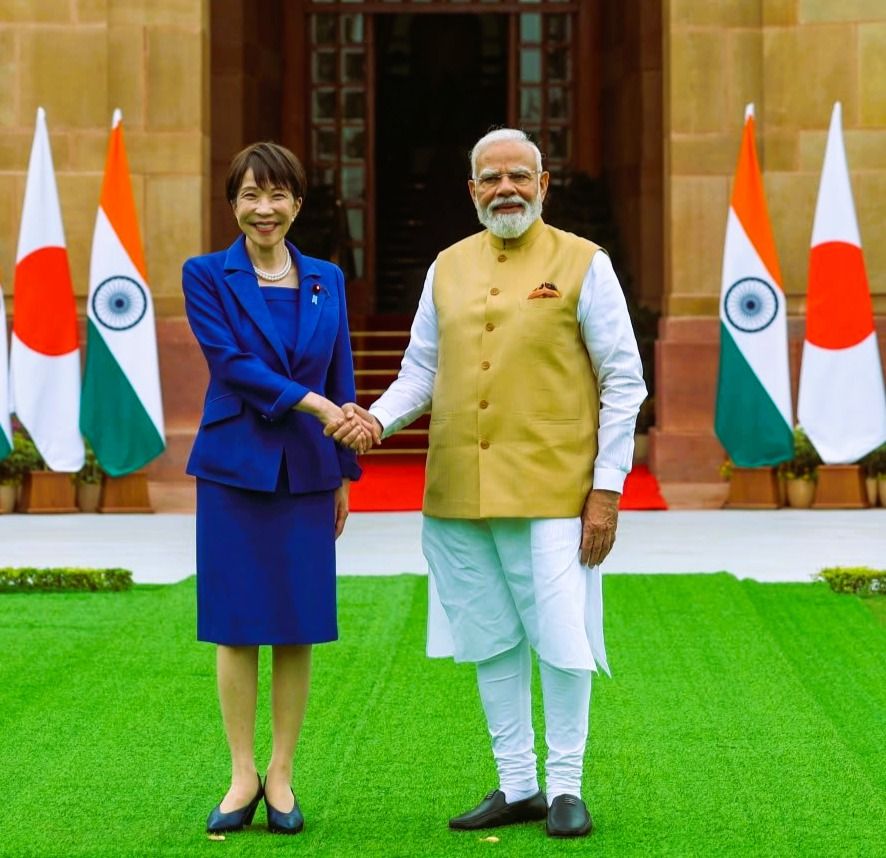
The entire atmosphere became thrilled when Prime Minister Narendra Modi and Japanese Prime Minister Sanae Takaichi tied their mutual relations with the cordial bond of brother-sister relationship at the 16th India-Japan Annual Summit at Hyderabad House here on Thursday. Following a nearly two-hour meeting between the two countries, four Memoranda of Cooperation were signed and exchanged. These included documents on cooperation in geological mineral exploration, pharmaceuticals and medical equipment, battery manufacturing, and the establishment of biogas and organic fertilizer plants. Furthermore, the two countries issued a joint statement in the field of AI and agreed on a joint development project in the defense sector.
Earlier this morning, the Japanese Prime Minister was formally welcomed at the Rashtrapati Bhavan courtyard. Following this, talks took place between Prime Minister Narendra Modi and his counterpart Takaichi. Later, during the joint statement, Prime Minister Modi addressed the Japanese Prime Minister as “my younger sister, Prime Minister Takaichi ji,” prompting Prime Minister Takaichi to become emotional. In her remarks, she also referred to the Prime Minister as “my elder brother, Prime Minister Modi,” and said, “You called me a dear younger sister, but in the small meeting before the big one, we confirmed that we share a common vision and will continue to nurture this relationship as brothers and sisters.”
Prime Minister Modi stated that India aims to attract 100 trillion yen (Japanese currency) of investment from Japan and double the number of Japanese companies operating in the country over the next 10 years.
Describing the Indian and Japanese economies as complementary, the Prime Minister said, “The economies of India and Japan are complementary. From cultural values to modern technology, our thinking and approaches also share similarities.
And above all, the foundation of our relationship rests on unwavering mutual trust. I am confident that this special partnership of ours will take your vision of a strong and prosperous Japan, our resolve for a developed India, and global progress to new heights.
Let us together realize your vision of a strong and prosperous Japan, our resolve for a developed India, and global progress.” He reiterated that mutual trust is a major strategic asset for both countries in the current climate of global turmoil.
Prime Minister Modi, while sharing the consensus and decisions reached during the talks, said that in today’s uncertain times, both India and Japan fully understand the importance of economic security and energy security. Toward this end, today we have developed a joint roadmap for economic security. Through this, we will strengthen supply chain continuity in strategic sectors such as semiconductors, quantum, and advanced materials.
We have also taken several important decisions in the field of energy security. Through the India-Japan Biogas Initiative, we will support the establishment of 1,000 biogas and organic fertilizer plants in India. This will further strengthen our Govardhan initiative.
This will invigorate stability, prosperity, and rural livelihoods in Indian villages. Today, we have also launched an important initiative on energy resilience to address situations like oil shocks. Furthermore, our cooperation in batteries, green hydrogen, and nuclear energy will significantly contribute to the world’s clean energy future.
India and Japan together view economic security as a shared security, and the energy transition as a shared opportunity, and we will work towards advancing and transforming them.
In his statement, Modi said that technological cooperation remains a strong pillar of the partnership between the two countries. Realizing this vision, the two countries today issued a joint statement in the field of AI. The confluence of Japan’s technological capabilities and India’s software capabilities will give new impetus and strength to global AI development. He also informed that the two countries have agreed on the first joint development project between India and Japan in the defense sector.
Referring to the healthcare sector, the Prime Minister said that India’s vast capabilities and Japan’s quality are capable of providing affordable, reliable, and advanced healthcare to the world. The India-Japan investment partnership is continuously strengthening. Nearly 120 new business agreements have been signed in the past year, bringing Japanese investment worth over US$10 billion to India.
In the joint statement with his Japanese counterpart, the Prime Minister reiterated support for an Indo-Pacific with a free, prosperous, and rules-based order
Japanese Prime Minister Sanae Takaichi said, “Japan and India should harness our respective strengths to become stronger and more prosperous together. Amid the turbulent international environment, it has become even more important to build such a complementary and cooperative relationship. In this context, when Prime Minister Modi and I discussed various issues, we were reminded of the many goals we share. We agreed to place three areas at the center of our cooperation. First, deepen strategic cooperation between Japan and India. Our two countries share a common vision for the kind of international order we want to build in the current global environment. I recently announced the updated FOIP (Free and Open Indo-Pacific), which emphasizes self-reliance and strength to realize FOIP. Prime Minister Modi, on the other hand, views the ocean as a shared space that contributes to regional stability and development. He is promoting the ‘Ocean’ initiative, which will enable countries around the Indian Ocean to safeguard their sovereignty and maritime security. We can do it ourselves; this initiative is fully consistent with the FOIP. Thus, we agreed to further deepen strategic cooperation between Japan and India to achieve such shared goals. Expanding maritime security cooperation is particularly important for regional peace and stability.
Takaichi said, “A destroyer from the Japanese Maritime Self-Defense Force and an Indian Navy ship are planning to conduct joint exercises. We will increase exercises in the Indian Ocean, promote cooperation in naval maintenance, repair, and overhaul, and strengthen cooperation in equipment under the ‘Make in India’ framework. To further deepen such cooperation, I have instructed the relevant departments to discuss and hold the next Japan-India 2+2 meeting before the end of the year. Second, we need to promote Japan-India cooperation in the areas of economic security and energy security. As both countries face challenges such as economic weaponization and non-market practices, we urgently need to strengthen our critical minerals supply chains.” Furthermore, in the area of energy security, affected by the situation in the Middle East, both Japan and India have a responsibility to ensure energy security for the entire region, as I explained in ‘Power Asia.’ That is why we have issued a document for the public and private sectors – a joint statement on concrete steps for economic security cooperation under the ‘Power Asia Initiative’; we will initiate bilateral discussions to strengthen India’s petroleum storage system. Japan also supports India’s membership in the IEA. In the area of energy transition, India aims to leverage cooperatives to build 1,000 biogas plants to generate energy from cow dung.”
She said, “We are launching the ‘Japan-India Cooperative Biogas for Growth’ (CBG) initiative, introduced by Prime Minister Modi. The third objective is to jointly advance the economic growth of both India and Japan through cooperation in investment and innovation. We are committed to building a strong economy and aim to enhance Japan’s supply and technology capabilities through investments in 17 strategic sectors. Prime Minister Modi has launched the ‘Develop India’ initiative, with the national goal of becoming a developed country by 2047, and he is accelerating India’s development journey. Thus, we both share the goal of making our countries stronger and more prosperous through investment in the future. Representatives of the business community in the Japanese delegation are strongly supporting our two countries in achieving these shared goals. During this visit, approximately 120 agreements related to cooperation between Indian and Japanese companies were announced, including investments worth 2 trillion yen.
Takaichi said, “We wish to chart the future for India and Japan through the combined efforts of the public and private sectors. Next year marks the 75th anniversary of our diplomatic relations, and we want to seize this opportunity to bring the people of our two countries closer under the India-Japan Special Strategic Global Partnership, so that we can become trusted partners who share strategic direction. I am confident that together with my elder brother, Prime Minister Modi, India-Japan relations will enter a new era. I look forward to welcoming Prime Minister Modi to Japan next time.”
Tags:


Related Post