


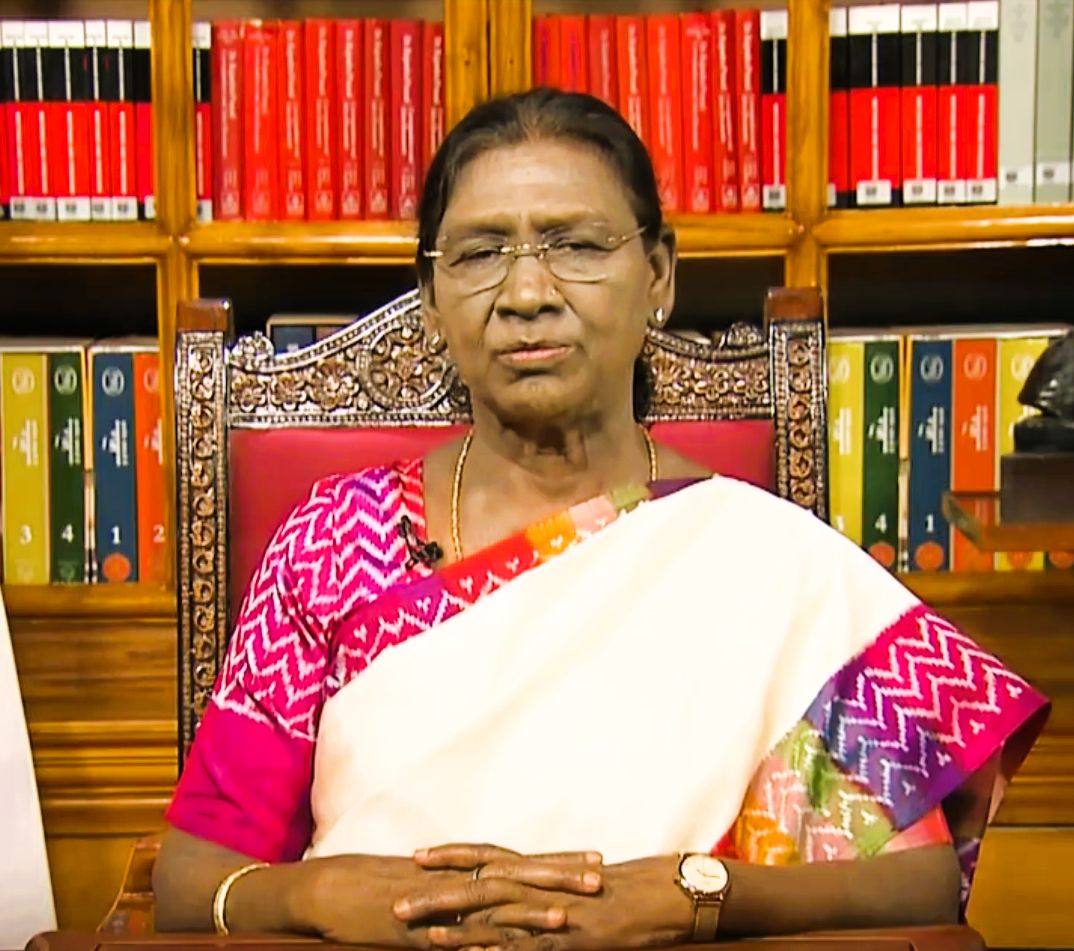
Students are makers of nation’s future, says Prez Murmu; calls for transparent, secure, and reliable examinations

New Delhi, August 14: President Draupadi Murmu on Friday described students as the makers of the country’s future and stressed the need for comprehensive reforms to make public examinations transparent, secure, and reliable. She stated that the government’s effort is to completely curb unfair means in examinations and provide young people with a fair opportunity to advance based on their talent.
In her address to the nation on the eve of the country’s 80th Independence Day, the President highlighted various aspects of the country’s development journey, including building a developed India by 2047, youth power, women empowerment, welfare of the poor and underprivileged, digital and physical infrastructure, economic development, environmental protection, foreign policy, and national security. Before the President’s address, ‘Vande Mataram’ was played, a first in history. The national anthem ‘Jana Gana Mana’ was then sung.
She said, “Our students are the makers of India’s future.” Just as national security requires the unity of government and society, the security of students’ present and future requires everyone’s collective efforts. Public examinations open doors of opportunity for students, so the government is undertaking comprehensive reforms in these examinations. These reforms aim to make the examination system transparent, secure, and trustworthy for the youth.
The President noted that approximately 65 percent of the country’s population is under the age of 35, and this youth population represents India’s most valuable asset. He emphasized that Indian youth are talented, committed, and skilled, and are finding innovative and practical solutions to problems. Referring to the recent successful rocket launch by a young team with an average age of only 28, he said it has ushered in a new phase of space exploration.
He added that youth are embracing a culture of self-employment as well as employment, and their efforts have fostered a strong startup ecosystem in the country. Impressed by the talent and dedication of Indian youth, even major global companies are offering them leadership roles.
The President highlighted the increasing participation of women in various sectors, including education, agriculture, defense, sports, and entrepreneurship. He said that women are making their mark in new areas, from Drone Didi to becoming fighter combat leaders in the Air Force.
He stated that more than 100 million women are associated with self-help groups, and the goal of making 30 million women Lakhpati Didi has been achieved. Now, the target is to make 30 million more women new Lakhpati Didi. Nearly two-thirds of the entrepreneurs benefiting from the Mudra Yojana are women.
The President stated that the increasing voting participation of women is a significant achievement of Indian democracy. The Nari Shakti Vandan Act was passed in 2023 to ensure 33 percent representation for women in the Lok Sabha and Legislative Assemblies.
Referring to the accelerated pace of inclusive development over the past decade, the President said that more than 250 million people have been lifted out of poverty. He said that under the Pradhan Mantri Jan Dhan Yojana, nearly 590 million account holders are connected to the banking system, of which more than 320 million are women.
He said that food security has been ensured for nearly 800 million people through the provision of free rations, while under the Ayushman Bharat Pradhan Mantri Jan Arogya Yojana, nearly 600 million people have access to free medical care up to Rs 5 lakh per year. The Kisan Samman Nidhi and Kisan Credit Cards have strengthened farmers engaged in activities such as dairy, poultry, fisheries, and beekeeping, along with agriculture.
Murmu listed India’s digital infrastructure as one of the country’s major achievements, saying that digital payments have reached small shops and street vendors in villages. He stated that India accounts for more than half of the world’s real-time digital transactions.
Citing the expansion of highways, waterways, railways, and airways, he said that the expansion of modern infrastructure has increased opportunities for new enterprises, employment, and investor confidence.
The President stated that despite war and instability in many parts of the world, the Indian economy is growing rapidly. According to economic projections, India’s growth rate is expected to be more than double the global average. He stated that the Self-reliant India campaign has strengthened the foundation for economic progress and national security.
He noted India’s progress in renewable energy and sustainable development, emphasizing environmental protection as a responsibility towards future generations. He urged people to make individual and collective efforts to protect the environment, in line with campaigns such as “Ek Ped Maa Ke Naam” and “Lifestyle for Environment.”
Regarding national security, the President praised the valor of the Indian Armed Forces, citing Kargil Vijay Diwas and Operation Sindoor. He said that Operation Sindoor is a testament to the unwavering capability of the Indian armed forces against terrorism and that a clear message has been sent to terrorists and their supporters that they will be punished for their actions.
He described the suspension of the Indus Water Treaty, signed in the past with a country that harbours terrorism, as a decisive step in the interest of the country, especially farmers.
The President said that Naxalism had been a serious challenge for the country for decades, but making India Naxal-free is a major achievement. He said that there is now an atmosphere of enthusiasm in the Naxal-affected areas and the flow of development is reaching them. Referring to the large participation of people in the Bastar Olympics and Bastar Pandum, he called it a sign of change.
The President said that India is moving forward to build a developed India by the centenary of independence in 2047. Central to this goal is the spirit of Antyodaya (the ultimate goal) and the delivery of development to every person. Paying homage to freedom fighters, he recalled the contributions of Mahatma Gandhi and Dr. Bhimrao Ambedkar.
Referring to August 14th as Partition Horrors Remembrance Day, he paid tribute to the millions of people killed in the Partition violence and those who suffered the tragedy of displacement. Referring to the challenge of unifying over 550 princely states at the time of independence, he described Sardar Vallabhbhai Patel as the architect of modern India’s unity.
The President said that India’s foreign policy is based on national interest, and its main pillars are peace, cooperation, dialogue, and Vasudhaiva Kutumbakam. He said that India is playing a leading role in the Global South and believes in a rules-based international order. Referring to free trade agreements with various countries, he emphasized the need for adequate representation of the world community in multilateral institutions.
Describing Indian cultural heritage as the nation’s spiritual strength, the President noted the inclusion of 12 forts associated with the Maratha military tradition on the UNESCO World Heritage List. He said that India’s heritage includes spiritual monuments associated with Lord Buddha, as well as symbols of its glorious traditions and military capability to defend its self-respect.
Quoting lines from Telugu litterateur Gurajada Apparao, the President said that the nation does not mean only the soil, but the entire population. He expressed confidence that with the participation of society and the efforts of the government, people in every village, town, and home across the country will become healthy, happy, and prosperous.
He called upon the countrymen to dedicate themselves to the national pursuit of transforming independent India into a developed India with a spirit of inclusive patriotism.
Tags:
Related Post