





National water security strengthened as Jal Shakti Abhiyan delivers record recharge works, surpassing extraction levels: Report

New Delhi, August 10: India annually recharges about 449 BCM of groundwater from rainfall and natural sources, of which nearly 247 BCM is extracted for agriculture, households, and industries, but with several states facing overuse pressure, the Jal Shakti Abhiyan has completed over 20 million water conservation and artificial recharge projects, the Jal Sanchay Jan Bhagidari initiative has added more than 15.5 million recharge and storage works, and the Amrit Sarovar Yojana has developed or revived around 69,000 reservoirs, significantly boosting the nation’s water sustainability efforts.
According to the 2025 Groundwater Resources Assessment Report of the Central Groundwater Board (CGWB), Ministry of Jal Shakti, a total of 449 BCM of groundwater is recharged annually in the country. Of this, approximately 408 BCM is extractable for various needs. Of this, 247 BCM of groundwater is extracted for all uses in the country.
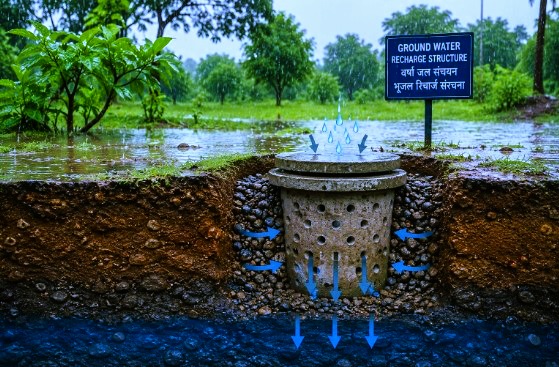
After rainwater falls on the ground, a portion of it percolates down through layers of soil and rocks and accumulates underground. This is called groundwater recharge. This groundwater is extracted through wells, tube wells, and other means for agriculture, drinking water, domestic needs, and industry. However, not all of the water that reaches the ground through rain is available for use. Therefore, of the total recharge of 449 BCM, 408 BCM is considered the annual extractable groundwater resource.
Union Water Power Minister C.R. Patil, while answering a written question in the Rajya Sabha, stated that the largest portion of the 247 BCM of groundwater extracted in the country is used for agriculture. Of the total groundwater extraction, approximately 215 BCM, or 87 percent, is used for irrigation purposes. Meanwhile, 28 BCM, or 11 percent, is used for domestic and drinking purposes. Industries use approximately 4 BCM, or 2 percent, of groundwater. This clearly indicates that the greatest pressure on groundwater in the country is due to agricultural and irrigation needs.
According to the Central Ground Water Board, the national groundwater extraction level is 60.63 percent. Approximately 61 percent of the annual groundwater extraction capacity is currently being extracted. However, this average represents the overall situation, and the situation varies significantly across states and districts.
Nine states and union territories have groundwater extraction levels higher than the national average of 60.63 percent. These include Punjab, Rajasthan, Haryana, Delhi, Puducherry, Tamil Nadu, Uttar Pradesh, Chandigarh, and Karnataka. At the district level, 281 districts across the country have been found to have groundwater withdrawal levels higher than the national average.
According to the report, groundwater quality also varies across regions. Groundwater is generally potable across the country, and nearly 99 percent of monitoring stations have found it suitable for irrigation. However, some areas have problems with fluoride, nitrate, salinity, and other contaminants. Groundwater quality depends on the geological and local conditions of different regions, so states or districts are not ranked solely on the basis of “worst groundwater quality.”
Data from Bihar also revealed problems with salinity, fluoride, and nitrate in groundwater in some areas. In 2025, five samples tested 584 groundwater samples from Bihar, with electrical conductivity exceeding the permissible limit. Fluoride was found in 39 samples, and nitrate was found in 78 samples.
Large-scale work is underway across the country to conserve and restore groundwater. Under the Jal Shakti Abhiyan, more than 20 million water conservation and artificial groundwater recharge projects have been carried out so far. Bihar has also completed approximately 5.75 lakh such works.
Furthermore, under the Jal Sanchay Jan Bhagidari initiative launched in 2024, over 1.55 crore artificial groundwater recharge and water storage projects have been completed across the country, including approximately 7.26 lakh projects in Bihar. Furthering this initiative, the Jal Sanchay Jan Bhagidari – Catch the Rain campaign was launched on June 1, 2026, focusing on conserving rainwater and infiltrating it underground. Work is
also underway under the Amrit Sarovar Yojana to increase water storage and groundwater recharge across the country. To date, approximately 69,000 Amrit Sarovars have been developed or revived, including 2,613 in Bihar. Rainwater storage in these reservoirs not only increases local water availability but also helps recharge groundwater.
According to the Ministry of Jal Shakti, the average per capita water availability in the country is declining. According to the Central Water Commission’s 2024 assessment, the average annual per capita water availability in the country in 2021 was 1,573.19 cubic meters.
Tags:


Related Post