



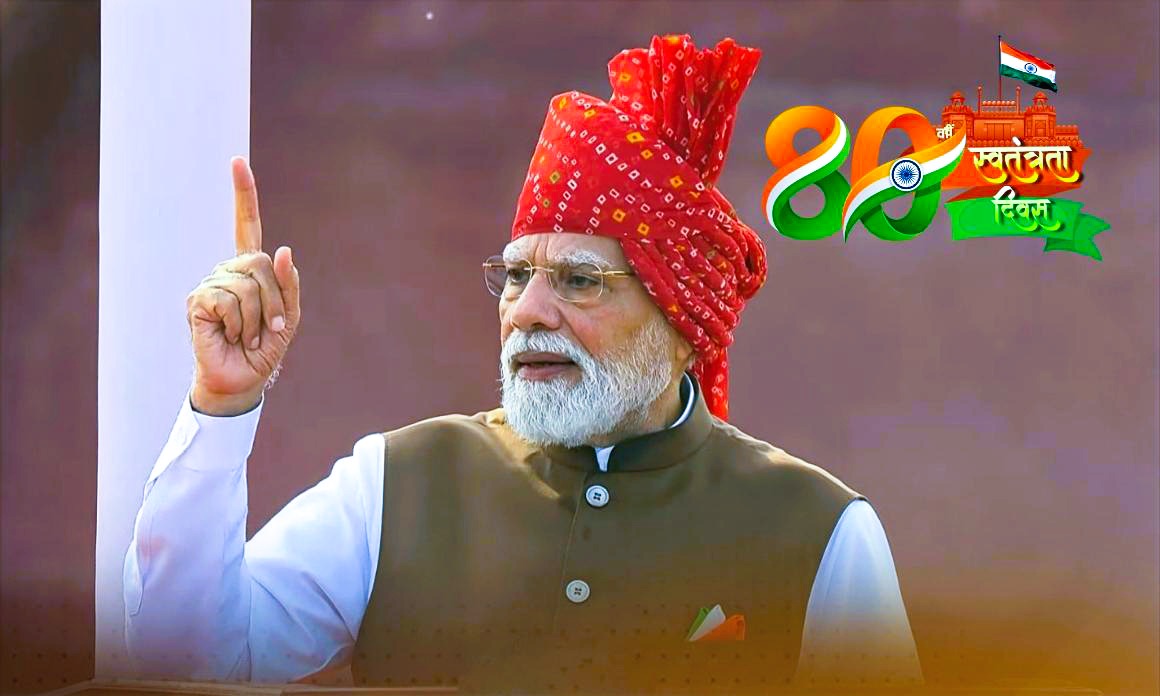
80th Independence Day speech: PM Modi calls for accelerated growth, warns against naxalites

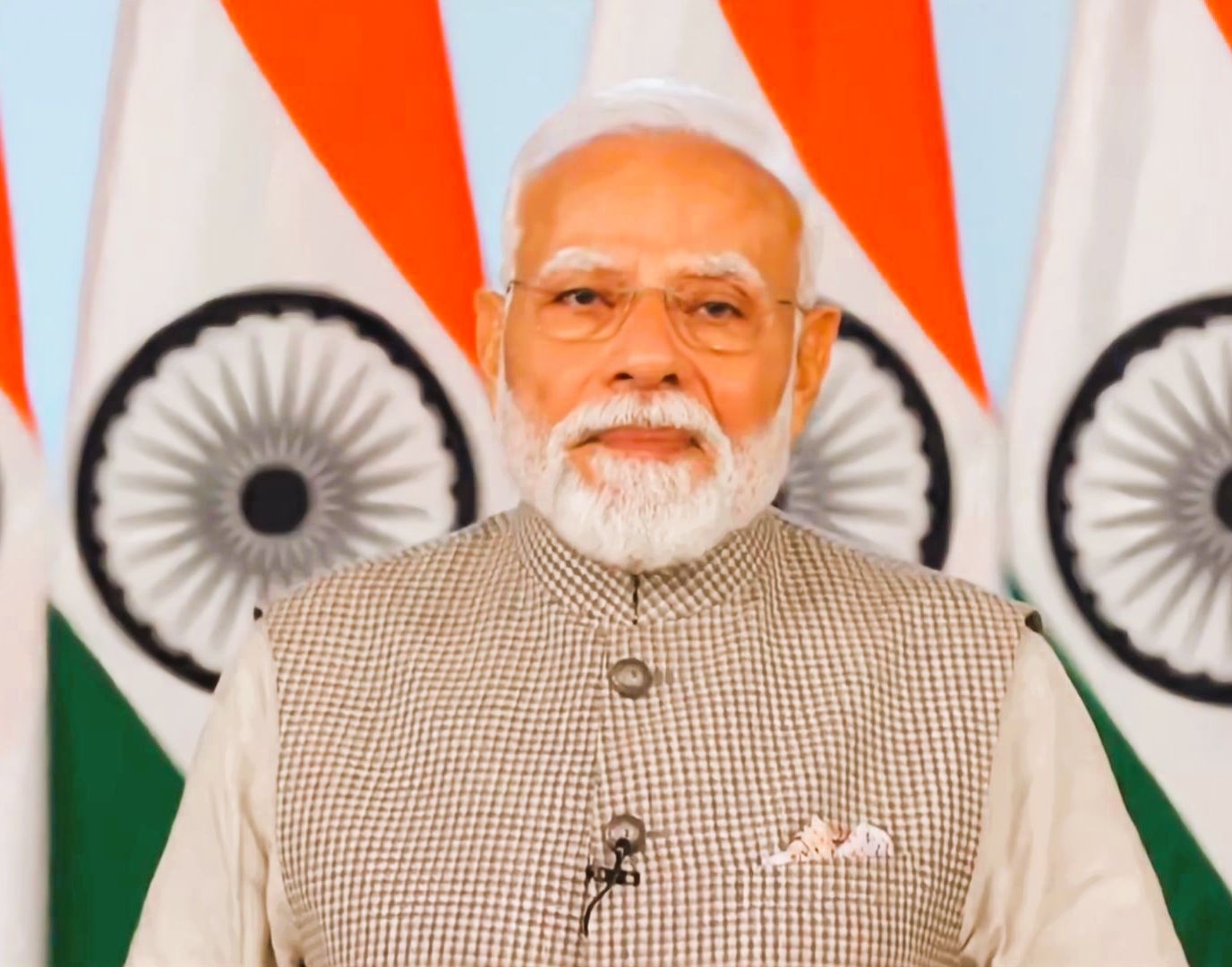
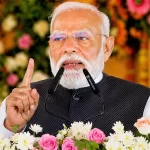
New Delhi, August 15: From the ramparts of the Red Fort on Saturday, Prime Minister Narendra Modi called for accelerating development to achieve the goal of a developed India by 2047. To achieve this, he emphasized the need to enhance the Sapta Shakti (seven forces). These Sapta Shakti (seven forces) include production, agriculture and food processing, technology and innovation, speed power, self-reliance in the defense sector, a green economy, and India’s soft power. He also appealed for caution against mindless Naxalites, emphasizing the need to connect the country’s youth with the goal of a developed India.
The nation is celebrating its 80th Independence Day today. In his address to the nation from the ramparts of the Red Fort, the Prime Minister spoke of transforming dreams into resolve, resolve into strength, and strength into success.
In his nearly hour-and-a-quarter speech, the Prime Minister highlighted the government’s achievements over the past 12 years. Describing the efforts toward self-reliance as the most significant, he said that as a result, the country remained strong even during crises like the one in West Asia. He noted that today, the world is breaking free from the trap of globalization and weaponizing supply chains. In such a situation, it becomes even more essential for the country to become self-reliant. Toward this end, the government has launched the “Samudra Manthan” project, with an outlay of 85,000 crore rupees, to explore oil and mineral reserves. He said that due to a lack of understanding, mineral exploration in 99 percent of the oceans had not been considered until now.
He said, “Cheap and easily available foreign goods may provide immediate benefits, but they do not develop the country’s own capabilities. Therefore, a commitment to a self-reliant India is essential.”
Targeting the opposition, the Prime Minister said that some people enjoyed scaring the country during the West Asia crisis, but the country has seen that the well-thought-out plans of the last 10 to 12 years are paying off. This is why the country is avoiding the crisis of petrol, diesel, and urea shortages. He said that despite the global price of urea reaching nearly 3,000 rupees per bag, it is being made available to Indian farmers for 300 rupees.
He said, “Vaccines will not be available, people will not survive COVID, nothing is going to happen… The West Asian crisis hit, petrol pumps were shut down, gas was shut down, diesel was shut down, fertilizer was shut down… Some people were enjoying spreading rumors from around the world, scaring the people of India, intimidating them, and drowning them in anxiety. But the country has seen that the well-thought-out plans of the last 10-12 years are bearing fruit. And despite such a huge crisis, India’s preparations, the steps taken one after another, based on the mantra of ‘Nagrik Devo Bhava’, all came in handy during the crisis, and today the country has gas, petrol, and urea.”
The Prime Minister considered the youth as the biggest beneficiary of the goal of a developed India by 2047 and said that it is very important to connect them with this goal.
Along with this, the Prime Minister appealed to the countrymen, especially the youth, to be cautious of the mindless Naxalites. He said that these mindless Naxalites, who have been in power for decades, are now looking for opportunities and are searching for new ways of anarchy. These people are using various tricks to drag the society on the wrong path. He said that the country has succeeded in eliminating the murderous Naxalites, now there is a need to identify and isolate the mindless Naxalites.
He said, “In 2014, when you gave us the opportunity, we pledged to free the country from Naxalism. Today, I am happy that Naxalite-Maoist violence has lost even a last breath. The armed Naxalites are gone, but the mindless Naxalites are waiting for an opportunity. They are exploring violence and anarchy. They are using various tactics to mislead society. These mindless Naxalites must be identified.”
Modi also made several announcements on behalf of the government. He said that the country will train 10 million youth in artificial intelligence (AI) in one year. To prepare for the 2036 Olympics, a talent search program will be launched for children aged five to 15 in sports in which India is not participating. He said that many families have to spend a lot on coaching their children for competitive exams. India will use its digital infrastructure to create a complete infrastructure for online coaching classes for various competitive exams. He also said that citizens will be provided civil defense training to strengthen the country’s internal security.
The Prime Minister appealed to all political parties to support the passage of the bill providing 33 percent reservation to women in the Lok Sabha and state assemblies. He said that increasing women’s participation in politics is the need of the hour, and all parties should come forward to protect women’s respect and rights.
Modi called on the youth to actively participate in the census. He said that the census is not just a data collection exercise; it is based on this information that policies, plans, and the country’s development plan are formulated. Therefore, providing accurate and detailed information will be a significant contribution to national development. Due to the availability of technology, citizens can enter census information themselves using mobile phones. He urged the youth to check the information with family members and then enter it digitally. He said that accurate information will help improve government schemes and policies.
The Prime Minister said that India’s global profile is continuously strengthening. A stable political mandate, a stable government, a vibrant democracy, a strong judicial system, and a Constitution are India’s strengths. The world is now recognizing these potentials. The move towards free trade agreements with nearly 40 countries since 2014 is a reflection of this changing global landscape.
Modi described free trade agreements as a major opportunity for Indian industry, especially micro, small, and medium enterprises. He emphasized the need for Indian textiles, machinery, pharmaceuticals, and other products to reach the global market. To achieve this, Indian products must meet global standards with superior quality and competitive pricing.
He emphasized the need for a developed India, necessitating a shift in work culture, mindset, and pace. The goal should be to accomplish what remained unfulfilled in the past five to seven decades in the coming five to seven years. Expressing confidence in the power of youth, women, farmers, and laborers, he called for accelerating the pace of reforms.
The Prime Minister urged Indian companies to aim for a greater global role. He called for 50 Indian companies to be listed on the Fortune 500 list within the next decade, for an Indian bank to be among the top five global banks, and for Indian companies to be among the top pharmaceutical companies. He also emphasized the need for Indian leadership in global law, consulting, and accounting firms.
He emphasized the need for reforms to be a matter of trust, not a compulsion or burden for the government. With this belief, India is moving forward in a new direction of reforms. He said that all sectors, including the government, society, industry, and farmers, must reform their traditional systems, thinking, and goals to create a new system in line with a developed India.
Modi said that with the expansion of artificial intelligence, chips, and data centers, energy needs will increase rapidly. Describing nuclear energy as an important means for energy security, he set a target of 100 gigawatts of nuclear power capacity by 2047. He announced that five new nuclear reactors will be commissioned in this decade.
Wishing the countrymen a happy 80th Independence Day, the Prime Minister said that today every heart resounds with Vande Mataram, and every home, every mind is connected to the tricolor. He also expressed condolences to the families affected by floods and other natural disasters in parts of the country. He said that the country understands their pain and suffering and assured the affected families that the government and the entire nation stand with them.
He invoked the stream of seven powers for a developed India. He said that in the coming five-seven years, these seven powers will be used to accomplish those tasks which could not be accomplished in the last several decades. Through these powers, the goal was to give new momentum and height to the country by connecting the youth power with nation building.
Prime Minister Modi said that India will have to develop the entire value chain from small parts to big products. From design to manufacturing, India will have to become a reliable hub of the global supply chain. Global standards of cost, quality and production capacity will have to be met. He called upon entrepreneurs and MSMEs to establish their identity in the global market on the basis of reliability and quality.
He stated that global markets are opening up for Indian farmers following trade agreements. He emphasized the need to expand access from farm to export markets. Emphasis was placed on developing millets, spices, fruits, flowers, and traditional food products into global brands and promoting chemical-free farming.
The Prime Minister highlighted artificial intelligence, quantum technology, space, robotics, and data centers as emerging opportunities. He stated that India needs to become not just a global market but also a hub of innovation. Following the success of digital public infrastructure, he set a goal of leading in next-generation communication technologies and advancing India-developed 6G.
Modi emphasized fast and seamless connectivity, highlighting the need to connect cities with high-speed rail, develop modern highways, inland waterways, airports, and multi-modal transport systems. He emphasized the need to transform ports into hubs of port-based development and economic activity, rather than merely cargo handling centers.
The Prime Minister stated that self-reliance in the defense sector has become India’s primary concern. India should aim to become a global supplier by developing new-generation defense technologies. We should take leadership in drones, anti-drone systems, and hypersonic defense technology, and develop cybersecurity as a key area.
He called for achieving global standards in green hydrogen, renewable energy, energy storage, green mobility, and green manufacturing. Describing India’s long coastline as a major opportunity for the blue economy, he emphasized the potential for expansion in fisheries, coastal tourism, and marine technology.
The Prime Minister described yoga, Ayurveda, holistic health, faith centers, handicrafts, culture, film, visual effects, animation, gaming, and digital content as means to establish India’s global identity. He also emphasized the need to transform the creative economy into a global force and showcase India’s cultural strengths. He emphasized India’s immense potential in tourism and global events. He said that India’s soft power can connect global tourists, artists, and events to the country.
He noted that under the Startup India campaign, more than 250,000 startups have been registered in the country. Startups are playing a vital role in creating new opportunities and providing employment to youth. Referring to the announcement of an innovation fund of Rs 1 lakh crore by the government, the youth were assured that there would be no shortage of resources.
The Prime Minister mentioned initiatives like Skill India, Digital India, opening up the space sector to the private sector, the National Drone Policy, and Khelo India. He spoke about the creation of new opportunities for youth through the new education policy. He said that the number of universities has increased significantly compared to before 2014 and higher education has expanded. Referring to the expansion of medical education, the Prime Minister said that before 2014, there were approximately 400 medical seats in the country, while now this number has reached approximately 850. The arrival of foreign universities in India and the availability of their degrees in India was also described as a new opportunity for youth.
Modi mentioned Atal Tinkering Labs to foster interest in technology and innovation among children. He said that more than 10,000 such labs have been made available to children to develop technical thinking, experimentation, and innovation from an early age. He mentioned the achievements of youth in the private space sector. He said that young entrepreneurs have achieved remarkable success in satellite and rocket launches at a young age. This will open up new opportunities for private participation and young talent in the space sector.
The Prime Minister highlighted India’s progress in the bioeconomy. He stated that before 2014, the business was around ₹60,000 crore, which has now grown to nearly ₹20 lakh crore. Describing this as a result of clear policies and the potential of the youth, he described the bioeconomy as a sector with new opportunities.
He described drug addiction as a major challenge facing the youth and called for a drug-free India a collective responsibility. He informed about the 100-week campaign being launched in collaboration with My Bharat volunteers, non-governmental organizations, socio-cultural organizations, and spiritual leaders. He called on every family to join this campaign and contribute to a secure future for the youth.
The Prime Minister called for inspiration from the dreams of various great personalities, including Netaji Subhash Chandra Bose, Dr. B.R. Ambedkar, Jawaharlal Nehru, Sardar Patel, Bhagat Singh, Sukhdev, Rajguru, Dr. Shyama Prasad Mukherjee, Bhagwan Birsa Munda, and Jyotiba Phule. He emphasized that national interest and duty should prevail over personal interests.
In his address, the Prime Minister listed his government’s achievements and said that the collective efforts of the countrymen in the last 12 years have resulted in 250 million people being lifted out of poverty. India was once considered among the world’s weakest countries, but in the last 12 years, the country has made rapid economic progress.
The Prime Minister said that along with development, attention has also been paid to the facilities of ordinary citizens. Referring to the speed of providing tap water connections, gas connections, toilets for the poor, and the rapid construction of housing, he said that the government has worked to provide basic amenities on a wide scale.
Citing governance changes, he said that thousands of compliances have been eliminated and hundreds of outdated laws have been abolished. He said that 21st-century progress is impossible based on laws from the last century. He also cited the expansion of modern infrastructure, metros, and public transport as part of this transformation.
The Prime Minister described semiconductors as essential for the modern digital and technological world. He said that chips are needed in many sectors, including electronics, medical devices, and transportation. He highlighted the commissioning of three semiconductor plants in India and the export of their production, promising that many more plants will be commissioned in the coming years.
He highlighted India’s strategy, calling critical minerals essential for modern technology. With the announcement of the National Critical Minerals Initiative and the Critical Minerals Corridor, agreements are being signed with various countries. He said that many countries now trust India in the field of critical minerals.
Modi highlighted the progress made in the energy sector over the last 12 years. He said that the number of cities with piped gas has increased from 70 to 700, and the number of households with piped gas has reached nearly 20 million. The increase in solar energy capacity from 2 gigawatts to 160 gigawatts was also mentioned. He said that the PM Surya Ghar Free Bijli Yojana was launched to bring the benefits of energy transition to ordinary families and the middle class. Under this, he informed that solar energy work has been completed in 5 million homes.
The Prime Minister noted the change in the pace of railway electrification. He said that in the 90 years since the work began in 1925, only 30 percent of the rail network was electrified, while the remaining 70 percent was completed in the last decade. He also described the launch of the country’s first hydrogen-powered train as an important achievement.
Modi also called on states and local self-governments to accelerate reforms. He said that industry and society must move forward together with the central and state governments. Referring to the growth in the electric vehicle sector, the Prime Minister said that approximately 150,000 electric vehicles were sold in 2009-10, while this number will reach approximately 2.5 million in 2025-26. He mentioned new airports, routes, and employment opportunities in the aviation sector. He also linked new possibilities to aircraft maintenance and repair and Indian-made defense transport aircraft.
Citing the use of drone technology, he mentioned the SVAMITVA scheme. He said that property surveys in villages were conducted using drones, benefiting approximately 50 million families. This unlocked the economic potential of a large amount of property and created new opportunities for bank loans and businesses for people.
Prime Minister Modi stated that the goal of a developed India will be achieved only when the benefits of development reach the last person in society. He described the expansion of social security coverage as an important step in this direction. According to him, before 2014, approximately 250 million people had social security coverage, while in the last decade, this coverage has expanded to approximately 1 billion people. Modi mentioned the health coverage provided to the elderly and poor families through the Ayushman Bharat scheme. He said that free treatment and medicines are being provided even to those above 70 years of age.
Referring to his earlier call for Panchpran, he said that these resolutions have empowered the country to move forward towards self-respect. He called for continuously eliminating the mentality of slavery and drawing inspiration from the great leaders and revolutionaries who dreamed of India’s independence and nation-building.
Tags:

Related Post